
Emmanuel Ndikumana was born and raised in Burundi, most recently in the capital city, Bujumbura, where he has lived for over thirty years. He is a Langham Scholar, was personally impacted by the late John Stott, is a pastor in his local church, and has pioneered a ministry that seeks to mobilise the church and equip Christian leaders for servant leadership in his nation.
Burundi is “a land of contrasts, rich in many ways and yet ranked amongst the world’s poorest countries,” Emmanuel describes. “The people in general are joyful, yet the majority have experienced deep pain and are in need of healing,” he shares. Burundi’s fertile land receives rain approximately nine out of twelve months each year, yet intense population pressure has made survival increasingly difficult. Emmanuel explains, “With more than 85% of its people living on subsistence agriculture, land is becoming increasingly insufficient and can hardly feed its people as it used to do. The less land there is for family members to share, the more potential conflicts there are.”
The roots of Burundi’s suffering, Emmanuel believes, lie partly in its colonial history. Although Burundians share language, culture, traditions, and religion, Western powers imposed ethnic categories that did not reflect reality. “Burundian and Rwandese peoples are exceptions,” he explains, because “they cannot fit into the anthropological categories of tribes.” Yet they were categorised and ruled as Hutu, Tutsi, and Twa, a mistake that he believes “In many ways has been behind the devastating genocidal ethnic violence for which the two countries have been infamous.”
Christianity spread widely during the same colonial period, leading Burundi and Rwanda to be regarded as a missionary success. Yet Emmanuel reflects on how fragile that success proved to be: “When ethnic violence erupted in the early post-independence year, the much-appraised ‘Christian success’ quickly showed its irrelevance and lack of impact on social issues…This dichotomous understanding of the Christian faith in many ways explains why and how a more than 90% predominantly ‘Christian’ population could experience ethnic violence of genocidal magnitude and struggle to recover from it.” Still, he remains hopeful: “Today the church, in its diversity, is alive and thriving, increasingly conscious of both its failure, its potential, and its irreplaceable role to help bring healing to the wounds of the people, who happen to be its members.”
Emmanuel’s own journey into leadership and theological reflection began during his university years. “While in my second year at the University of Bujumbura in 1991, I received a scholarship for one year for a leadership programme in England.” During that time, he received theological books, including John Stott’s The Cross of Christ and Chris Wright’s Living as the People of God: The Relevance of Old Testament Ethics. These books were challenging and had a significant impact on him. He shares, “the book and the author made a lasting impression on me, opening my heart and mind to look for more than what I already had.”
Soon after his return home, Burundi descended into renewed violence. “In September 1993, one year after my return to Burundi, the country entered yet another destructive period of ethnic violence.” In February 1994, Emmanuel was appointed as the first General Secretary for the Burundi International Fellowship of Evangelical Students (IFES) movement, serving in the midst of the violence. He shares, “I was still very young and inexperienced, yet called to lead a group of about 200 Hutu and Tutsi Christian students, who loved the Lord and wanted to live out their faith.” The experience was overwhelming, as he and many of his mentors struggled to make sense of the violence. “This frustrating and confusing realisation raised more questions than I could answer,” he says, and by 1996, “I nearly reached burnout and decided to leave student ministry.”
It was at this point that Emmanuel’s relationship with Langham Partnership began to evolve. Encouraged by IFES leadership to take a break and study in England, he chose the London Institute for Contemporary Christianity (LICC). “When I learned that the author of ‘The Cross of Christ’ was the one behind LICC, I did not think twice.” There he encountered John Stott personally and was introduced to “his incredible ‘double listening’ approach to biblical interpretation.” Emmanuel remembers vividly, “My eyes were opened and my mind was enlightened! I remember him asking that I sit next to him for lunch on that first day. He asked me about my name and some news about Burundi. I have never had to remind him of my Kirundi surname which he pronounced amazingly well. Long before the course ended, I was so reenergised, that although the security situation had worsened, my wife and I decided to come back to Burundi to continue with the student ministry.”
Several years later, John Stott, whom Emmanuel affectionately calls “Uncle John”, visited war-torn Burundi. At the end of the visit, Emmanuel recalls, Stott asked him, “young man, what have you studied?” When Emmanuel admitted he had not completed his degree, having gone straight into ministry upon his return, Stott insisted, “you must stop everything and go back to study!” Although Emmanuel protested, saying, “‘Uncle, my head is too full!’” John Stott insisted he complete his degree to allow a solid foundation for what the Lord was doing. He pointed him toward All Nations Christian College, led by Chris Wright. Emmanuel’s immediate response was, “I will go there!”
Emmanuel reflects, “That is how I fell into the hands and the hearts of the two pastor scholars who so greatly influenced my thinking. They gave a solid foundation to my Pentecostal upbringing and identity by helping me develop an evangelical mindset, while IFES student ministry provided me with the ideal field in which to exercise it.”
All Nations Christian College became a turning point for Emmanuel. “All Nations Christian College delivered on its promise to be a place where I could process my many questions,” Emmanuel reflects. He graduated with a BA Honours degree in Biblical and Intercultural Studies and an MA degree in Aspects of Christian Missiology, with a special interest in political issues.
With the help of some friends, Emmanuel pioneered Partners Trust International, a ministry that seeks to mobilise the church for the holistic transformation of society and to equip Christian leaders for servant leadership. At the heart of the ministry is a Bible school, Great Lakes School of Theology and Leadership, which promotes contextual biblical and theological reflection around the issues the nation is confronted with. He shares, “My conviction was that however weak and tainted the church can be, it remains God’s special mission agent on earth. It is therefore our responsibility to do whatever we can to help it stand on its feet, with the help of its leaders, to play its irreplaceable role on this earth.”
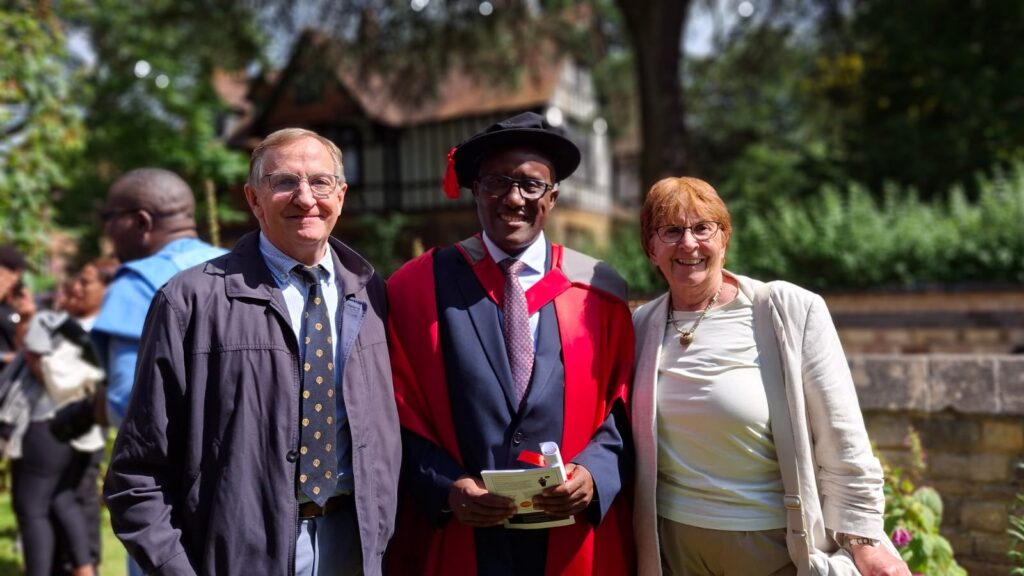
Graduating in 2024, with the support of Langham Partnership, Emmanuel undertook doctoral research through a scholarship at the Oxford Centre for Mission Studies. He explored the meanings both survivors and perpetrators of ethnic violence give to forgiveness and how their respective understanding influences reconciliation. “The insights I gained from this academic research are helping me to acknowledge the contribution of those I am working with today formulate a biblical and theological basis to mobilise politicians, civil servants, marketplace leaders, and church leaders under the theme of ‘the role of kings, priests, and prophets in the edification of the nation God wants, we desire and pray for’”, he explains.
Langham Partnership gave Emmanuel language for the tension he lived daily, between faith and citizenship, heaven and earth. “It was through the various programs of Langham Partnership that I learned that what the Bible teaches about God, Jesus, the church and the world are coherent; and can be reconciled with the reality of life here on earth. Langham Partnership helped me find the relevance of God’s Word and the Christian faith in this world which is full of contradictions. It also equipped me in how to share that relevance with many people,” he explains.
Underlying Emmanuel’s public ministry is a deeply personal faith shaped by loss. “Partially orphaned at 4 years old, when my father was murdered due to ethnic violence,” he was raised by his mother and grandmother. He remembers being “so fortunate to have a (loud) praying grandmother. Almost every morning before getting out of her bed and every night before sleeping, I overheard her reminding God that He promised to be a father to the fatherless and a husband to those who are widowed. She daily claimed that promise to ask Him for both protection and provision.”
When he later served with the Lausanne Movement and founded Partners Trust International, he carried what John Stott calls “the Langham Logic”—the conviction that the church must grow in both quality and quantity through faithful teaching of God’s Word. “The church must be fed on the Word of God which comes essentially through the preaching of the Word although not solely,” he explains.
Today, Emmanuel continues to serve across Burundi and the wider region. “I have been equipped to equip others both at home and abroad…I am still serving God’s people, although in a different context and capacity, more than three decades later,” he shares.
The African continent is experiencing the highest Christian growth in the world, and Emmanuel is passionate about the church playing an important role in keeping the flame of Christianity ablaze.
Thank God for Emmanuel, and the impact he is having in Burundi. Pray that he will continue to equip leaders to teach the Bible faithfully. Please pray that the leadership development initiatives he, together with some other faithful partners, has recently launched to unite the leadership of the wider church may bear fruit.
If you would like to equip more leaders in the Majority World, please click below.